Baby Elephant SVG: A Designer’s Real-World Embroidery Review
Let’s be honest—I opened the Baby Elephant SVG file not to admire it on screen, but to ask one question: *Will this stitch cleanly, hold up in real life, and make my customer smile when they unbox it?* I tested it on a custom embroidered organic cotton tote bag for a local baby boutique—soft fabric, medium-weight stabilizer, 4” hoop—and here’s what I learned.
First Impression: Sweet, Simple, and Surprisingly Versatile
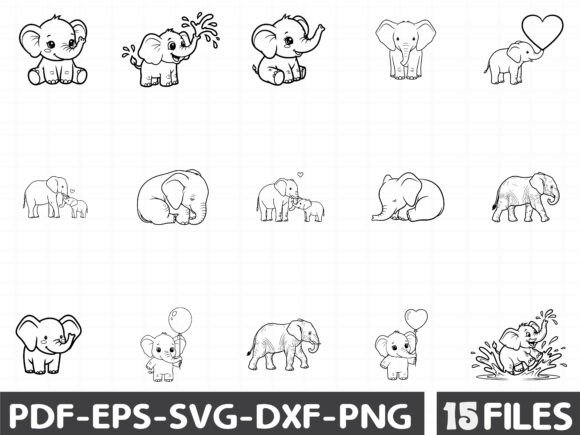
The Baby Elephant SVG lands with gentle charm—not cutesy overload, not overly minimal. It’s rounded, friendly, and just detailed enough: smooth curves for the trunk, subtle ear texture, no tiny eyelashes or micro-patterns that vanish under thread. That simplicity is its superpower. As an embroidery file, it avoids the common trap of “designer ambition”—no unnecessary gradients, no layered shadows, no fragile outlines. What you see is what will stitch: clean lines, balanced proportions, and intentional negative space.
It reads instantly as *baby*, *gentle*, *thoughtful*—perfect for nursery decor, personalized onesies, or a stitched tea towel gifted at a baby shower. But don’t box it in. I resized it down to 2.2” for a linen apron pocket and up to 5.5” for a sweatshirt chest placement—and both held visual weight without distortion. That adaptability matters when you’re juggling Etsy listings, craft fair inventory, and client requests.
Where It Shines (and Where It Needs Care)
In real embroidery projects, the Baby Elephant SVG performs best where clarity and warmth matter most:
- Soft baby items: Onesies, burp cloths, and swaddle blankets—its smooth silhouette avoids snagging and reads clearly even at small sizes.
- Tote bags & tea towels: The open shape stitches quickly, with low stitch density. No dense fill areas that cause puckering on woven cotton or linen.
- Patches & applique designs: Clean outer edge = easy cut-and-sew. Works beautifully as a standalone embroidered patch or base for fabric applique.
- Holiday & gift embroidery: Paired with a simple “Welcome Little One” quote from the same 100 Unique Digital Quote Design Pack, it becomes a cohesive, heartfelt set—not just decoration, but narrative.
But realism means naming limits too. Avoid using Baby Elephant SVG on:
- Ultra-thin fabrics like voile or lightweight rayon without extra tear-away stabilizer—it needs structure to hold shape.
- Highly textured surfaces (like bouclé knit or heavy terry cloth) unless you test first; those soft curves can blur on uneven terrain.
- Curved, tight spaces like cap fronts—its width-to-height ratio doesn’t compress well on domed surfaces without manual adjustment.
- Dark fabrics with light thread unless you add a satin stitch outline or underlay; subtle contours need contrast to read.
What It Adds to Your Finished Product—Beyond Stitching
A good embroidery file doesn’t just translate to thread—it shapes perception. With Baby Elephant SVG, customers consistently describe the finished product as “so tender,” “calm,” and “made with care.” That emotional resonance lifts perceived value. A $28 embroidered pillow cover feels intentional, not mass-produced. A $36 personalized sweatshirt reads as heirloom-quality, not trendy fast craft.
For Etsy sellers and small shop owners, that matters deeply. This isn’t background filler—it’s a quiet brand signal. When used across a boutique’s line (towels, onesies, greeting cards), it builds recognition without shouting. And because it’s part of a broader pack of quote designs, you can pair it thoughtfully: “Little feet, big love” beneath the elephant, or “Gentle soul” beside it—no forced matching, just harmonious tone.
Practical Notes Every Embroidery Designer Should Check
Before stitching your first Baby Elephant SVG project, run through these quietly critical steps:
- Test on scrap fabric first—especially if using stretchy knits or dark backgrounds. See how the trunk curve holds, how the ear detail resolves.
- Review stitch density in your embroidery software. If it’s over 8,500 stitches, consider simplifying interior details for baby wear.
- Confirm hoop size compatibility. At full size, it fits comfortably in a 5x7 hoop—but verify before hooping a delicate garment.
- Inspect corners and curves at 200% zoom. Look for jagged vector points or unintended overlaps that could cause jump stitches.
- Mock it in black and white on both light and dark fabric previews. Does the shape still read? Does the scale feel right next to text?
- Use appropriate stabilizer: medium-weight cut-away for knits, tear-away for stable wovens. Skip the fusible unless testing first—the design’s openness doesn’t need heavy backing.
- Verify licensing for commercial use. Since it’s part of the 100 Unique Digital Quote Design Pack, confirm whether resale of finished embroidered goods is permitted—and whether digital redistribution (e.g., as part of a larger design bundle) is allowed.
Final Thought: Not Just an Illustration—A Quiet Connector
As an experienced designer reviewing hundreds of graphics each year, I’ll say this plainly: Baby Elephant SVG isn’t flashy. It won’t go viral for complexity. But it connects—in a hospital gift bag, on a toddler’s backpack, stitched into a wedding guest book cover for the couple’s first child. Its strength is restraint, its value is reliability.
If you’re building a craft business rooted in sincerity—not speed—this is the kind of illustration that earns repeat customers. It supports your voice instead of competing with it. It works as a machine embroidery design, a printable mockup anchor, a digital embroidery file for client approvals, and a handmade product centerpiece—all without demanding constant tweaking.
Just remember: even the gentlest elephant needs thoughtful stitching. Test. Adjust. Trust your eye—and your customer’s hands—more than the file name alone.